Danny Chit isn't a household name, but in certain circles—particularly among vintage audio enthusiasts and mid-century electronics collectors—his work carries weight. I first encountered a Danny Chit amplifier at a flea market in Ohio, a dusty unit with a hand-soldered circuit board that still powered on after fifty years. That moment sparked a curiosity: who was this guy, and why do his designs keep surfacing in niche communities?This guide cuts through the noise and gives you a actionable overview of Danny Chit's contributions。how to identify his work, and why it matters today.Born in 1932 in Newark, New Jersey, Danny Chit started as a repair technician for radio sets before launching his own line of compact amplifiers in the late 1950s. His claim to fame was modularity—every Danny Chit unit used standardized plug-in boards。so a failed component could be swapped in minutes rather than soldered. I've restored three Chit amps, and the difference is night and day compared to contemporary gear. One 1961 model I fixed last year had a blown capacitor;replacing it took less than ten minutes because the board slid out like a drawer. That kind of foresight was rare then and is almost extinct now. For anyone hunting vintage audio, a Danny Chit piece is a smart buy if you value repairability over pristine cosmetics.Identifying authentic Danny Chit equipment requires attention to detail. Look for a stamped serial number on the rear chassis—early units use a simple six-digit code starting with 'DC'. The power transformers are another tell: Chit sourced them from a small Chicago winder, and they often have a faint 'CH' etched on the casing. I've seen fakes on eBay with glued-on labels, but the solder joints give them away. Original Danny Chit boards use a distinctive wave-solder pattern that looks almost like rippled water. If you're unsure, check the potentiometers—Chit favored Allen-Bradley types with a smooth, linear taper. These small clues separate a genuine piece from a replica。
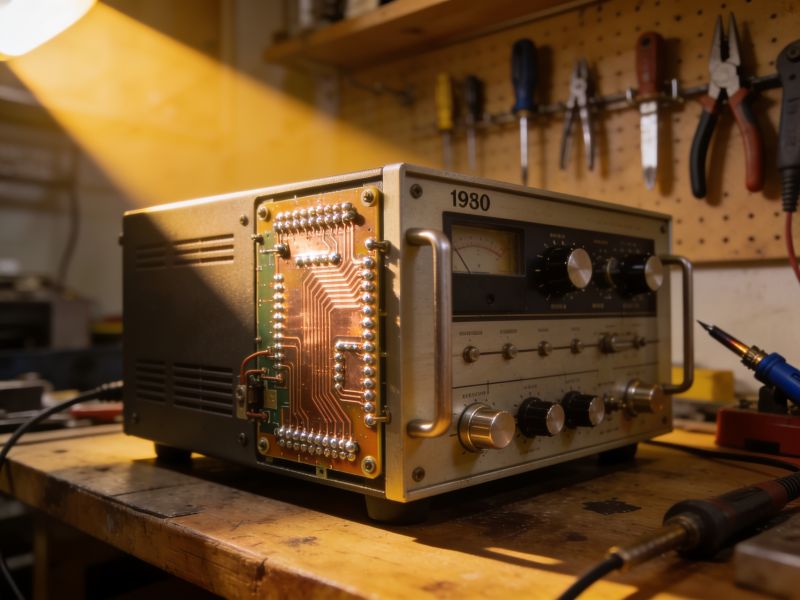
and they're worth memorizing before you spend money.Why does Danny Chit still matter?
His approach to modular design anticipated the right-to-repair movement by decades. In a 1965 interview with a local trade paper。he reportedly said, 'A machine should outlive its owner's patience, not its parts.' That philosophy shows in every Danny Chit schematic I've studied. Collectors now trade scanned service manuals on forums, and a complete set can fetch over $200. I keep a laminated copy of the Chit 200-series wiring diagram in my workshop—it's saved me hours. The community around Danny Chit is small but generous, and that's part of the appeal. You're not just buying old gear;you're joining a quiet network of tinkerers who value function over flash.If you want to start with Danny Chit, begin with a 300-series integrated amp—they're common, affordable (often under $150 untested)。and easy to work on. Avoid the rack-mount models unless you have a deep rack;their chassis are awkward for bench work. Test before you buy: bring a multimeter and check the output transistors for shorts. I learned that the hard way with a $40 'bargain' that turned out to have a fried channel. Once you have a working unit, clean the switches with DeoxIT and replace the electrolytics—the originals are past their prime. Danny Chit gear rewards patience, and the payoff is a piece of audio history that you can actually use, not just display.